



Why Corporate Offices Are Investing in Digital Signage Systems in 2026
There is a question sitting quietly behind most corporate fit-out decisions in Australia right now. It is not “do we need digital signage?”, that conversation largely settled itself during the hybrid work transition. The question that matters in 2026 is “why are the offices that are getting this right pulling further ahead of the ones that are not?”
The answer has less to do with screens and more to do with what those screens are doing. Corporate digital signage systems have moved well past lobby displays and meeting room directories.
In 2026, they are the infrastructure through which Australian businesses communicate with a distributed workforce, surface real-time operational data, demonstrate ESG commitments, and make the physical office feel worth the commute. That is a fundamentally different value proposition than a digital noticeboard, and it is why the investment conversation in boardrooms across the country has shifted from “is this worth it?” to “how quickly can we implement this properly?”
The Problem With How Most Corporate Offices Currently Communicate
Before examining what corporate digital signage systems make possible, it is worth being direct about what they are solving.
Most Australian corporate offices rely on a combination of email, intranet platforms, and printed notices to communicate with their workforce. Each of these channels has a structural problem. Email competes with hundreds of other messages for attention and is routinely ignored by the employees who most need to see it. Intranet platforms require staff to actively seek information rather than receiving it passively. Printed notices are static, expensive to update, and invisible to anyone who did not happen to walk past at the right moment.
The result is an information environment that is simultaneously over-crowded and under-effective. Employees miss critical updates. Important announcements reach some teams and not others. The physical office environment communicates nothing deliberately, it simply exists as a space people move through without the building itself doing any communicative work.
For businesses managing hybrid workforces, where the proportion of staff in the office on any given day varies significantly, this communication gap becomes more acute. The staff who are in the office need the environment to work harder for them. The office needs to justify its existence as a destination, not just a location.
What Corporate Digital Signage Systems Are Actually Being Used For in 2026
The corporate applications of digital signage have expanded considerably beyond what most decision-makers picture when the topic is first raised. Understanding what is actually being deployed in Australian corporate environments in 2026 reframes the investment conversation entirely.
Internal Communications That Reach Everyone, Not Just Inbox Checkers
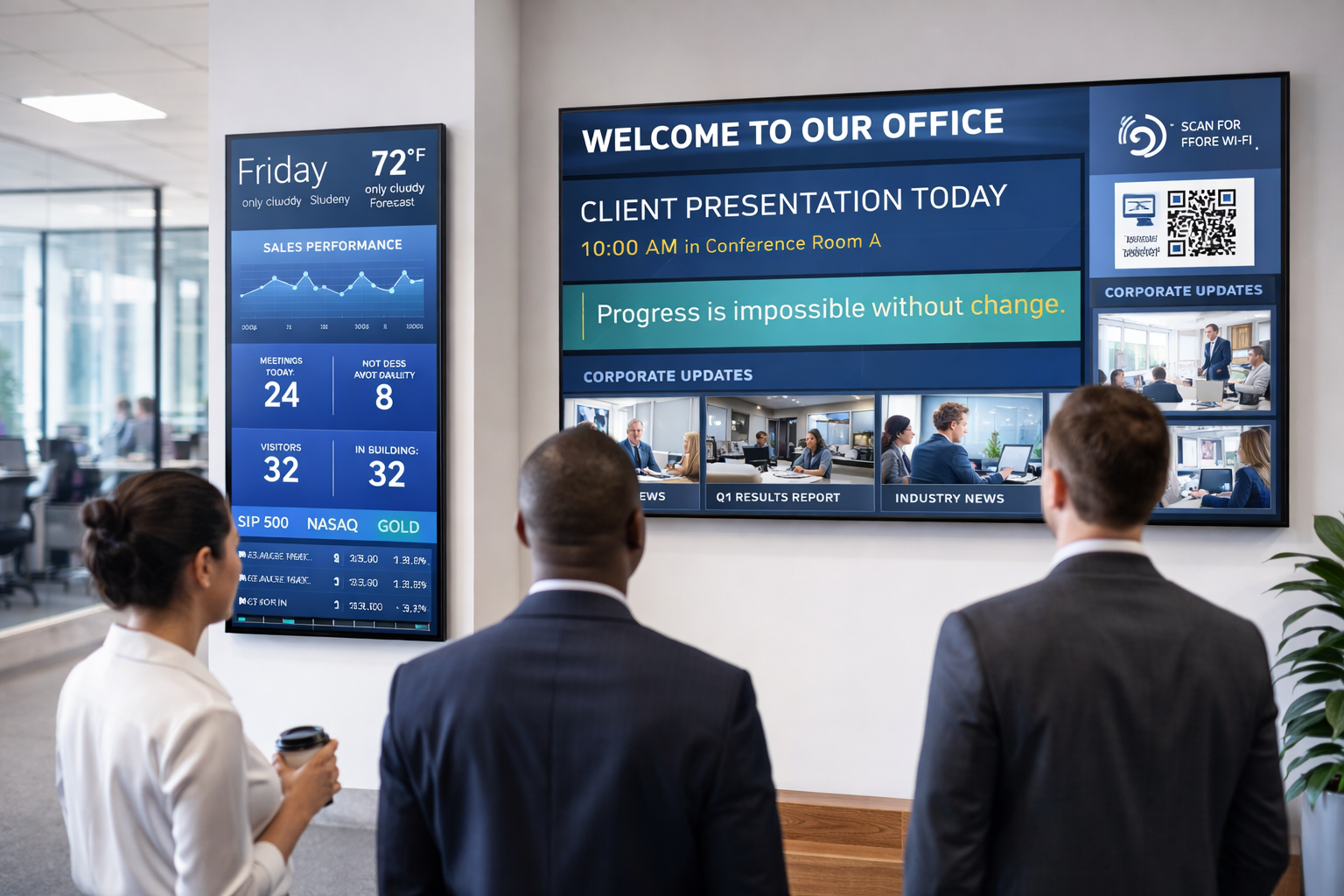
The most immediately impactful application in most corporate environments is internal communications delivered through screens rather than email. A display in a break room, corridor, or lift lobby reaches every employee who passes it, including the desk-less workers, the field staff visiting the office, and the employees who have not opened the intranet in three weeks.
Content at this level includes team announcements, company milestones, HR reminders, upcoming events, safety notices, and culture-building content. None of this is new information, all of it was being communicated before. What changes is the certainty of reach. A message on a screen in a high-traffic corridor will be seen by the people who need to see it. An email may not be.
For organisations with multiple floors or buildings, centralised content management means the same message appears consistently across every screen simultaneously, without anyone walking the floor, replacing printed notices, or sending a follow-up email to confirm the first one was read.
Real-Time Operational Dashboards
Corporate offices that have moved beyond basic signage are using screens to surface live operational data, sales performance, customer service metrics, project status, supply chain visibility, financial targets, in shared spaces where teams can see how the business is performing in real time.
This is not about surveillance or pressure. It is about alignment.
When a team can see the numbers that matter to the business on a shared screen in their work area, the connection between daily activity and organisational outcome becomes tangible in a way that a monthly report or a quarterly all-hands meeting cannot replicate.
The practical implementation varies by industry and function, but the principle is consistent: screens connected to live data feeds turn shared spaces into operational nerve centres rather than passive waiting areas.
ESG and Sustainability Reporting Made Visible
One of the more significant emerging applications of corporate digital signage in Australian offices is the display of ESG, Environmental, Social and Governance, metrics in shared spaces. As Australian businesses face increasing stakeholder pressure to demonstrate progress against sustainability commitments, the gap between what is reported externally and what is communicated internally has become a credibility issue.
Screens displaying live energy consumption data, carbon reduction progress, community investment figures, or diversity and inclusion metrics do something that a PDF report cannot, they make the commitment visible, daily, to the people whose behaviour and decisions determine whether those commitments are met. For corporate tenants in sustainability-rated buildings, this alignment between the physical environment and the ESG strategy is increasingly expected rather than aspirational.
Hybrid Workforce Alignment
The hybrid work model has created a communication asymmetry that most Australian businesses have not fully resolved. Remote employees receive information through digital channels. In-office employees receive the same digital communications but also occupy a physical environment that, in most cases, is not doing any additional communicative work.
Corporate digital signage closes this gap by making the physical office an active communication environment. Room availability displays ensure in-office staff can navigate the space efficiently on days when attendance is higher than expected.
Screens in shared areas surface the same project updates, announcements, and performance data that remote employees receive through digital channels, creating parity of information regardless of where a team member is working on a given day.
The office environment needs to offer something the home setup does not. An office that communicates actively, surfaces relevant information passively, and makes the working day more navigable is a more compelling destination than one that simply provides a desk.
The Environments Within a Corporate Office That Benefit Most
Not every screen in a corporate environment delivers equal value. Understanding which spaces benefit most from digital signage helps businesses prioritise their investment and avoid deploying hardware in locations where it will not earn its keep.
Reception and lobby areas are the highest-visibility locations in any corporate office. Screens here communicate brand values, welcome visitors, display company achievements, and set the tone for the environment before any conversation takes place. For businesses that host clients, partners, or prospective employees, the reception presentation carries significant weight.
Meeting room and boardroom entrances benefit from room booking displays that show real-time availability, current and upcoming bookings, and one-touch check-in or release functionality. This removes the friction of double bookings, reduces the time staff spend searching for available rooms, and creates a more professional impression for visiting clients. Digital advertising display screens installed at meeting room entrances are one of the most practical and immediately appreciated applications in any corporate fit-out.
Break rooms and communal areas are where employees spend time away from their primary workstation, which makes them ideal locations for internal communications, culture content, and operational updates that do not require immediate action but benefit from consistent visibility.
Corridors and lift lobbies are high-traffic, low-dwell locations. Screens here need to communicate quickly, brief announcements, wayfinding information, and time-sensitive updates suit these locations best.
Boardrooms and executive spaces use large-format displays for presentations, video conferencing, and data visualisation. The AV requirements for these environments are distinct from general office signage and typically require professional specification and installation to perform at the level executive environments demand.
Why Professional Installation Determines Whether the System Delivers
The technology behind corporate digital signage systems is well established. What separates a system that performs reliably from one that creates ongoing frustration is almost always the quality of the installation and the planning that preceded it.
Screens mounted incorrectly, cabling managed to a residential rather than commercial standard, content management systems configured without input from the teams who will use them daily, these are the implementation failures that generate negative ROI and internal resistance to the technology.
A professionally installed corporate digital signage system begins with a detailed understanding of the office environment: the traffic flows, the communication priorities, the technical infrastructure already in place, and the internal capacity to manage content on an ongoing basis. The hardware selection, mounting approach, cabling, and configuration are then built around those specifics rather than applied generically.
For Australian corporate offices undergoing fit-outs, refurbishments, or technology upgrades, integrating digital signage into the broader AV and IT specification from the outset, rather than adding it as an afterthought, produces significantly better results at lower total cost. (Confirm installation scope and options with Sydney Audio Visual Specialists based on your office environment and requirements.)
Common Mistakes Corporate Offices Make When Implementing Digital Signage
The businesses that get the least value from their corporate digital signage investment tend to share the same implementation mistakes.
Treating it as an IT project rather than a communications strategy is the most consequential. The hardware and software are the delivery mechanism. What matters is what the system communicates and to whom. Businesses that deploy screens without a clear content strategy end up with expensive hardware displaying screensavers or outdated slides, which creates a negative impression rather than a positive one.
Underestimating the ongoing content management requirement is another consistent failure point. Digital signage requires regular content updates to remain relevant and effective. Businesses that do not assign clear responsibility for this, or do not build content management into someone’s operational role, find that screens become stale within weeks of installation.
Selecting consumer-grade hardware for commercial applications creates reliability problems over time. Commercial-rated displays are designed for extended operating hours and demanding environments. Consumer screens are not, and the maintenance costs and downtime that result from using them in a commercial context typically exceed the initial saving.
Finally, failing to engage the people who will use the system, the communications team, the facilities manager, the IT team, before implementation produces systems that do not align with how the office actually operates.
The best corporate digital signage systems are designed around the workflows of the people managing them, not retrofitted around the screens that were installed.
Speak With Sydney Audio Visual Specialists About Corporate Digital Signage
Primary CTA: Ready to explore corporate digital signage for your office, boardroom, or multi-site operation? View the range of digital advertising display screens or contact Sydney Audio Visual Specialists to request a consultation tailored to your environment. Contact Sydney Audio Visual Specialists
Secondary CTA: Not sure what your office needs or where to start? Speak with the Sydney Audio Visual Specialists team for honest, practical advice before you commit to any hardware or installation. Get in touch today
Frequently Asked Questions
What are corporate digital signage systems? Corporate digital signage systems are networks of digital displays managed through a centralised content platform, used within office environments to communicate with employees, surface operational data, support wayfinding, and reinforce brand culture.
Why are Australian corporate offices investing in digital signage in 2026? The primary drivers are the hybrid work transition, the need for more effective internal communications, and the growing expectation that physical office environments actively support productivity and culture rather than simply providing space.
How does digital signage improve internal communications in a corporate office? Digital signage improves internal communications by delivering information passively to employees through screens in high-traffic areas, removing the reliance on email open rates or intranet engagement. Announcements, HR reminders, company milestones, and operational updates reach every employee who passes a screen, including staff who do not regularly check digital communication channels, with no additional effort from the communications team beyond updating the content platform.
What is the difference between corporate digital signage and general commercial signage? Corporate digital signage is primarily focused on internal audiences, employees, visiting staff, and invited guests, rather than the general public. The content priorities are internal communications, operational data, culture building, and space management rather than promotional or advertising content.
How does digital signage support hybrid workforces? Digital signage supports hybrid workforces by ensuring the physical office environment communicates actively with whoever is present on any given day, regardless of whether attendance is full or partial. This makes the office environment more functional and more worth attending on hybrid working days.
Can corporate digital signage display live data and ESG metrics? Yes, in many configurations corporate digital signage platforms can connect to live data feeds, including sales dashboards, operational metrics, and ESG reporting data, and display them on shared screens in real time. The specific integration options depend on the content management platform and the data systems already in place within the organisation.
Do I need professional installation for corporate digital signage? Professional installation is strongly recommended for any corporate digital signage deployment. Commercial office environments have specific cabling, mounting, and configuration requirements that consumer-grade installation approaches do not address adequately. Professional installation ensures screens are correctly specified for each location, cabling meets commercial standards, and the content management system is configured in a way that the teams managing it can use effectively from day one.
How much disruption does installing digital signage cause to an operating office? The level of disruption depends on the scope of the installation and how it is planned relative to the office’s operating schedule. A well-planned installation coordinated around office hours, staged by floor or area, and integrated into a broader fit-out or refurbishment will typically cause minimal disruption.
What ongoing maintenance does a corporate digital signage system require? Corporate digital signage systems require regular content updates to remain relevant, periodic hardware checks to ensure screens and media players are operating correctly, and software updates to keep the content management platform current.
Can digital signage be integrated with existing AV systems in boardrooms and meeting rooms? In many corporate environments, digital signage operates alongside or integrates with existing boardroom and meeting room AV systems including video conferencing platforms, presentation displays, and audio systems.
About Sydney Audio Visual Specialists
Sydney Audio Visual Specialists provides tailored audio visual solutions including AV equipment hire, product sales, installation, repair, and maintenance. The team supports a wide range of client types and environments, including schools, boardrooms, hotels, meeting rooms, auditoriums, showrooms, commercial shopfronts, and corporate facilities, with a focus on reliable service and honest advice.