



How Does Digital Signage Improve Retail Customer Experience and Sales?

There are five moments in every retail customer’s journey where a sale is either won or lost. Most retailers know these moments exist. Few have done anything deliberate about them. Digital signage changes what is possible at each one — not by overhauling the store, but by ensuring the right message reaches the right customer…
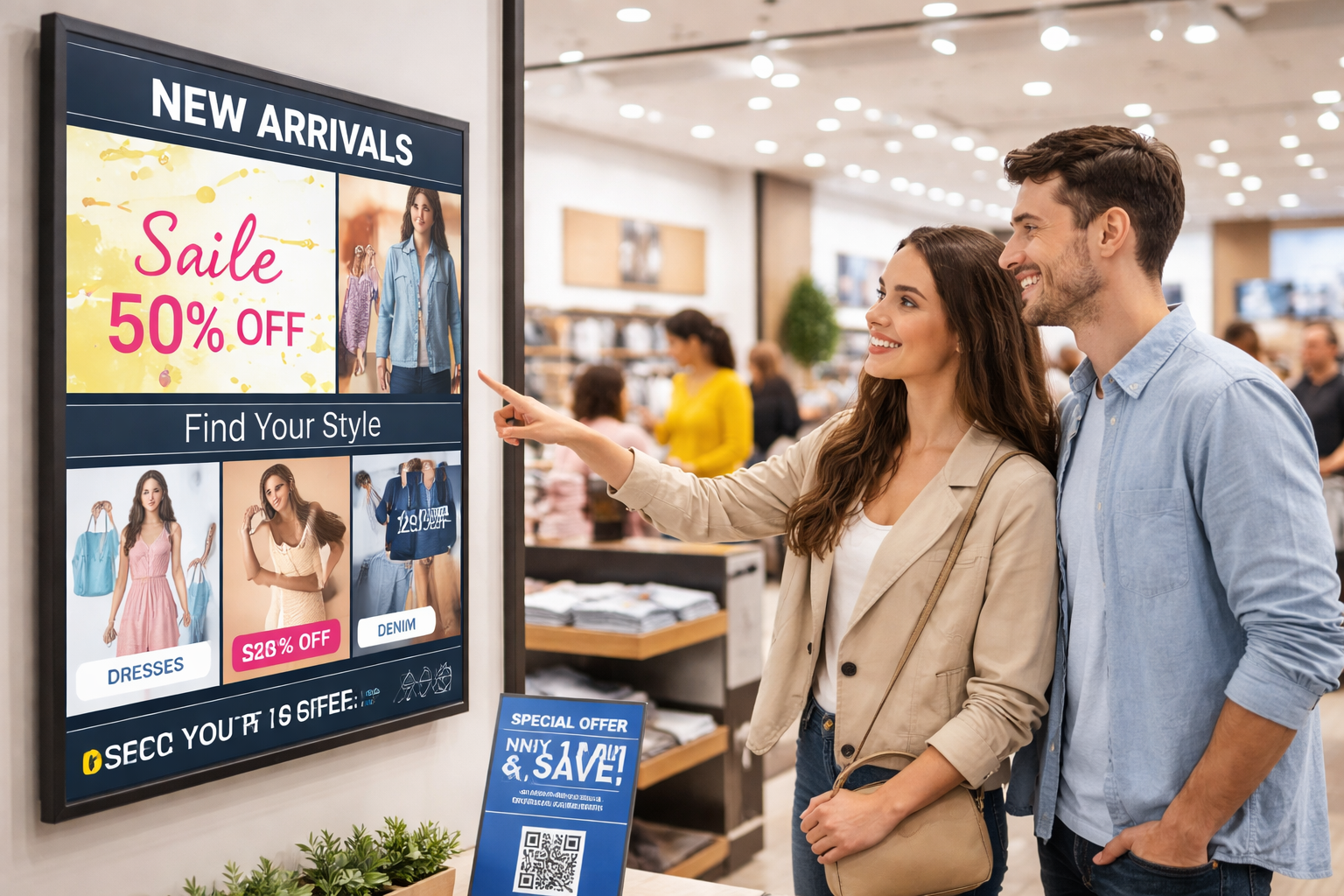
There are five moments in every retail customer’s journey where a sale is either won or lost. Most retailers know these moments exist. Few have done anything deliberate about them. Digital signage changes what is possible at each one — not by overhauling the store, but by ensuring the right message reaches the right customer at exactly the right time.
This is how it plays out, from the moment that matters least on its own to the one that ties everything together.
5. The Shopfront — The Sale That Starts Before They Walk In
A customer walking past your store has already begun making a decision. In the few seconds it takes to pass a shopfront, they assess whether what is inside is worth their time. That assessment is based almost entirely on what they can see from the outside, and for most retailers, what they can see is a printed poster that has not changed in weeks.
A static sign communicates one message, to every customer, regardless of what is currently relevant. It cannot reflect today’s promotion, this weekend’s offer, or the product that just arrived in stock. By the time it is replaced, the moment has already passed for every customer who walked by in the interim.
Digital advertising display screens at the shopfront change this equation entirely. The window display becomes a live communication tool, updated remotely, scheduled in advance, and always reflecting what is most relevant right now. A clearance event that starts Friday morning is live on every screen at the moment it begins, without anyone touching a single poster.
For Australian retailers in high-footfall locations, shopping centres, main streets, commercial precincts, this is not a minor operational convenience. It is the difference between a shopfront that actively earns foot traffic and one that passively hopes for it.
The sale does not start at the register. It starts at the window.
What your shopfront is communicating right now is either bringing customers in or letting them walk past.
4. The Entry — Eight Seconds to Shape the Entire Visit
Research into retail customer behaviour consistently points to the same finding: customers form their impression of a store within the first few seconds of entering. In that window, they are reading the space, deciding where to go, and making a rapid judgement about whether this environment is worth their attention.
Most retailers leave this moment entirely to chance. There is no deliberate direction, no active communication, no signal pointing the customer toward what the store most wants them to see. The customer defaults to their own path, which may or may not lead them past the products, promotions, or categories that matter most to the business that day.
A well-placed digital display at the entry point resolves this without requiring any staff involvement. It can direct attention toward a featured product, introduce a current campaign, highlight a loyalty programme, or simply present the brand in a way that creates confidence and sets a professional tone for the rest of the visit.
Eight seconds is not long. But it is long enough to either orient a customer toward a sale or lose them to a store layout they navigate entirely on their own terms.
This moment also carries significant brand weight. Digital advertising display screens presenting high-quality, current branded content communicate something important before a single word is spoken, that this is a business that is on top of its presentation, current in its communication, and worth engaging with. For retailers across commercial shopfronts, showrooms, and hotel lobbies, that first impression has lasting consequences for how the rest of the visit unfolds.
3. The Browsing Aisle — Where Decisions Are Forming and Screens Can Influence Them
A customer moving through the store is in the most receptive state they will be in during the entire visit. They are not yet committed to a decision, which means they are open to information, suggestions, and offers they did not arrive with. This is where the benefits of digital signage in retail are most commercially significant, and where most retailers are leaving the most value on the table.
Static signage in the browsing aisle presents the same message to every customer regardless of where they are in their decision process. It cannot respond to what is nearby, what is currently on promotion, or what a customer in that specific part of the store is most likely considering. It is a fixed message in a dynamic environment, and the mismatch costs sales.
Digital signage positioned thoughtfully along browsing paths and near product categories does something fundamentally different. It presents contextually relevant content based on location.
A screen near the homewares section surfaces content relevant to homewares customers. A screen in the electronics area responds to what an electronics customer is likely thinking about. The message matches the moment rather than ignoring it.
At this stage of the journey, a screen can highlight a complementary product, surface a bundle offer, answer a common pre-purchase question, or introduce a promotion the customer was not aware of, all without requiring a staff member to be present. Each of these interactions moves the customer forward in their decision process in a way that feels genuinely helpful rather than promotional.
For retailers with lean staffing models or large floor areas, this is operationally as important as it is commercially. The screen handles the communication that a staff member would otherwise need to initiate, consistently, at every hour the store is open.
2. The Product Display — Removing the Last Obstacle Before Purchase
A customer standing directly in front of a product is closer to a purchase than at any other point in their visit. The decision is forming. The question is whether the environment around that product gives them what they need to proceed, or leaves them with enough uncertainty to walk away and research further.
This is the moment that printed tickets and shelf labels most consistently fail to address. They communicate price and perhaps a product name. They rarely communicate the features that matter to this specific customer, the compatibility information that removes doubt, or the social proof that confirms the decision is a sound one.
The customer who cannot get the information they need at the shelf is the customer who takes out their phone, searches online, and either buys elsewhere or does not buy at all.
Digital advertising display screens positioned at or near product displays close this gap in a practical, scalable way. They can present product features in plain language, address the most common pre-purchase questions, show compatibility or sizing guidance, and display current pricing, all without a staff member needing to be within reach.
The cross-selling opportunity at this moment is also significant. A screen near a product display can show what other customers commonly purchase alongside it, present accessories or add-ons that increase the transaction value, or highlight a bundle that makes the decision easier rather than more complicated. This is not upselling in the aggressive sense, it is relevant information delivered at the exact moment a customer is already engaged and considering.
For Australian retailers managing multiple locations, the centralised content management advantage is particularly valuable here. A pricing update, a stock change, or a new product specification can be reflected across every relevant screen at every location simultaneously, no printed tickets to reprint, no store visits required, no lag between the change and its communication to the customer.
1. The Checkout — The Most Overlooked Opportunity in the Entire Store
The checkout queue is the moment most retailers have given up on. The customer is already there, already committed to spending, already waiting, and in most stores, there is absolutely nothing communicating with them while they do. That is a significant waste of the one moment in the entire visit where the customer is stationary, attentive, and has nothing else to do.
Digital signage near the checkout and queue area transforms this dead time into one of the most productive communication opportunities in the store. The customer in this position has the undivided attention of someone who is already in a buying mindset. That attention can be directed toward a last-minute add-on, a loyalty programme sign-up, an upcoming promotion, or brand content that reinforces the quality of the decision they have just made.
The effect on perceived wait time is also practically relevant. Customers who have something engaging to look at while waiting consistently perceive the wait as shorter than those who do not. For retailers where queue experience affects customer satisfaction and return visit rates, a well-placed screen at checkout is one of the lowest-cost, highest-impact applications of digital signage available, and one of the most consistently overlooked.
The add-on suggestions that perform best at this moment are not aggressive or out of place. They are low-cost, contextually relevant items that complement what is already in the basket, suggested at a moment when the customer is already committed to spending and receptive to a final, practical nudge.
The Operational Reality Behind All Five Moments
Understanding how digital signage improves retail customer experience and sales at each of these five moments is one part of the picture. The operational case that supports the investment is the other.
The most immediate financial benefit is the reduction in print and distribution costs. Every promotion, pricing update, and product communication that previously required a print run, a delivery, and a physical installation can now be managed through a content platform and deployed to every screen at every location in minutes. For retailers running frequent campaign cycles, these savings are substantial and compound over time.
Beyond cost, the flexibility advantage changes how retail operations function day to day. Content is scheduled in advance and activates automatically. A Saturday morning promotion goes live at the scheduled time without anyone being present to make it happen. A campaign that needs to be pulled mid-week is removed from every screen immediately, from a single location, without a store visit.
For multi-site retailers, the consistency benefit is equally important.
Printed materials age, fade, get replaced inconsistently, and fall out of alignment with current brand guidelines between refresh cycles. Centrally managed digital screens ensure every location presents the same approved content at the same standard at the same time, which supports both brand integrity and the omnichannel alignment that matters when customers move between online and in-store environments.
What Goes Wrong When Retailers Get It Right on Paper but Wrong in Practice
The five moments framework only delivers results when the implementation behind it is sound. The retailers who invest in digital signage and see limited returns almost always share one or more of the same missteps.
Screens go in without a content strategy. The hardware is installed but nobody has planned what it will show, how often it will be updated, or who is responsible for managing it. Within weeks the content is stale, which undermines brand presentation rather than supporting it.
Placement decisions are made based on what is convenient rather than where customers are actually making decisions. A screen that is not in the natural line of sight of a customer in a particular part of the store will not deliver the engagement it is capable of, regardless of what is on it.
The wrong screen is chosen for the environment. A display rated for standard indoor use will not perform in a sunlit shopfront. Brightness, glare resistance, and commercial durability ratings need to match the specific installation location, not just the budget.
Professional installation is treated as optional. Incorrect mounting, inadequate cable management, and poor initial configuration create reliability problems that are far more expensive to fix after installation than to get right from the start.
The system is treated as permanent once installed. Digital signage requires ongoing content management to remain effective. Businesses that build this into their operational rhythm see consistent returns. Those that treat it as set-and-forget see diminishing results and eventually question the investment.
Talk to Sydney Audio Visual Specialists About the Right Setup for Your Store
Primary CTA: Ready to improve the customer experience and sales performance at your retail location? View the range of digital advertising display screens or contact Sydney Audio Visual Specialists to request a quote tailored to your environment .Contact Sydney Audio Visual Specialists
Secondary CTA: Not sure which screens suit your space or how to get started? Speak with the team at Sydney Audio Visual Specialists for honest, practical advice before you commit. Get in touch today
Frequently Asked Questions
How does digital signage improve retail customer experience? Digital signage improves retail customer experience by ensuring the store environment is actively communicating with the customer at every stage of their visit.The result is a customer who feels more informed and more confident throughout the visit.
What are the main benefits of digital signage in retail? The main benefits are stronger in-store engagement, greater promotional flexibility, reduced print and distribution costs, improved product visibility at key decision points, and measurable influence on purchasing behaviour.
Can digital signage directly increase sales? Yes, when implemented with a clear content strategy and thoughtful screen placement. Screens that surface relevant promotions at the browsing stage, reduce information friction at the product display, and present add-on suggestions at checkout all have a direct influence on purchasing decisions.
Which part of the store benefits most from digital signage? Every stage of the customer journey benefits, but the product display and the browsing aisle tend to deliver the most direct commercial impact because they are where purchasing decisions are actively forming.
How do Australian retailers measure the ROI of digital signage? ROI is most reliably tracked by establishing a clear baseline before installation and measuring against it consistently over time. Useful metrics include reductions in print and distribution costs, improvements in campaign activation speed, and sales performance of products featured on screens compared to those that were not.
Do I need professional installation for retail digital signage? Professional installation is strongly recommended for any commercial retail deployment. It ensures screens are mounted correctly and safely, cabling meets commercial standards, and the system is configured to perform reliably from the first day of operation. The cost of getting installation right from the start is considerably lower than the cost of rectifying problems after the fact.
What content performs best on retail digital displays? Content that is visually clear, concise, and directly relevant to the customer’s location within the store consistently performs best. Promotional offers, product features, bundle suggestions, lifestyle imagery, and loyalty programme reminders are all effective. Content should be updated regularly and scheduled to ensure the right message appears in the right location at the right time of day.
Can digital signage integrate with other AV equipment already in my store? In many retail environments, digital signage operates alongside existing audio visual systems including background music platforms and public address systems. Integration is possible in a number of configurations, but compatibility depends on the specific equipment involved.
About Sydney Audio Visual Specialists
Sydney Audio Visual Specialists provides tailored audio visual solutions including AV equipment hire, product sales, installation, repair, and maintenance. The team supports a wide range of client types and environments, including schools, boardrooms, hotels, meeting rooms, auditoriums, showrooms, commercial shopfronts, and corporate facilities, with a focus on reliable service and honest advice.